
Owasso City Directory Collections
Owasso does not have one uninterrupted, town-only run of city directories. The strongest local starting point is the Tulsa City-County Library system, whose Oklahoma Room lists Tulsa directories from 1909 onward and confirms selected volumes from 1928 through 1932, 1939 through 1941, and 1948. Those books can still catch Owasso people, businesses, and street references in a wider Tulsa-area record. The table separates a verified run from a general collection claim, because a gap in a shelf list is not proof that a household was absent.
| Collection | Years | Where held | Access |
|---|---|---|---|
| Tulsa city directories, Oklahoma Room | 1909 onward in the library guide; verified 1928-1932, 1939-1941, 1948 | TCCL Central Library Research Center | Print, microfilm, and reference use; confirm a particular year in the catalog. |
| Polk-Hoffhine Tulsa City Directory | 1920 and 1921 inspected | TCCL Digital Collections, Central Library Local History Collection | Free digitized page viewer with alphabetical, classified, and numerical sections. |
| Owasso Ledger | Title began 1903; digital issues observed from 1904-1905 | Oklahoma Historical Society Gateway | Full text and metadata search; the digital run is incomplete. |
| OHS research collections | Dates vary by collection | Oklahoma Historical Society | Onsite, catalog, and research access; indexing and restrictions vary. |
Use an exact year as the first filter. A directory often lists private citizens, organizations, public offices, churches, schools, banks, and a numerical street section, but it is still a dated publication. The historical directory collection is a way to locate a person or address in that edition, not a complete roll of every person connected with Owasso.
Owasso City Directory Shelves at TCCL
The TCCL Genealogy Resource Center holds books, microfilm and microfiche, readers, maps and atlases, surname files, journals, subscription databases, and Family History Library affiliate access. It can be a practical fallback when a digitized result is missing a page or a desired year is not available online. Staff do not undertake unlimited research, although book-a-librarian appointments and focused written questions may be possible as time permits. The center also accepts obituary-copy requests at rcaskus@tulsalibrary.org.
For an Owasso city directory question, give the librarian the name as printed, a rough year, an address or community label, and any variant street spelling. The cited guidance lists black-and-white copies at $0.10 and color at $0.25, while scans to a flash drive or email PDF are free. A library card is needed for many subscription databases, but not for print holdings. That difference matters when an old name must be checked at the shelf rather than through a home search.
Note: A catalog gap or a failed name search should be recorded as an access gap, not treated as proof that the person never appeared in an Owasso directory.
Owasso City Directory Pages Online
The TCCL digitized city-directory collection gives the clearest online example of how a large regional volume is organized. The inspected 1921 Polk-Hoffhine volume is 400 pages, belongs to the Central Library Local History Collection, and includes alphabetical citizens and businesses, officials and institutions, a classified directory, and a numerical street directory. It was digitized in 2011 at 400 ppi JPG/TIF. Search results should be checked against the scanned page because initials and abbreviations can alter a transcription.
The 1921 directory viewer shows the title and repository context behind the digitized volume.
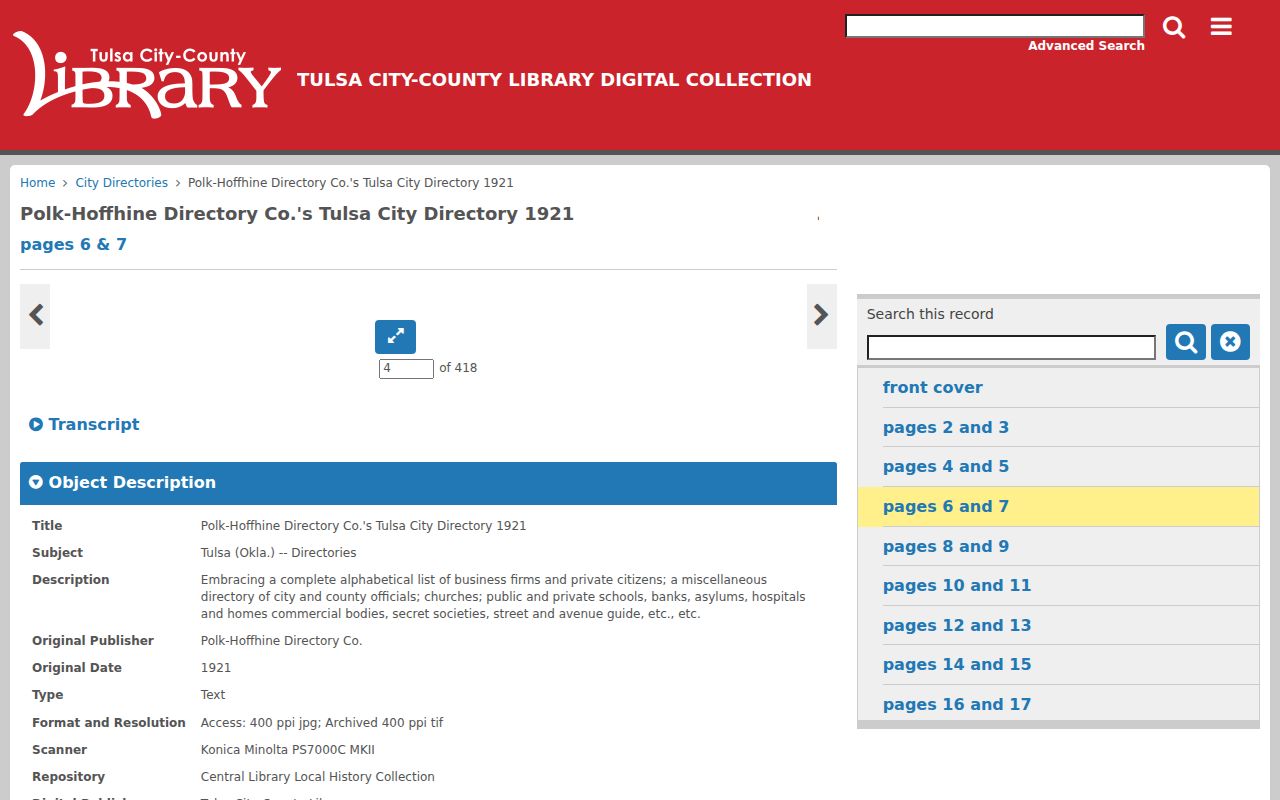
That collection view is a useful reminder to capture the volume title, year, and page with any entry. The same name can appear in an alphabetical listing and a street section, and those two placements answer different historical questions.
Reading an Owasso City Directory Entry
A directory entry is compact, and its marks need to be read as the editor used them. A 1920 TCCL sample shows a name, a spouse in parentheses where supplied, a historical classification marker in some entries, wording for an occupation or business, a residence marker, a rooms or boarding marker, and a numbered street. The source's classification language is historical source language, not a current demographic label. Preserve what is relevant to identification, but do not turn a brief historical entry into a modern profile.
| Indexed name | The printed name, initials, or business form used by the publisher. |
|---|---|
| Spouse marker | A name in parentheses where supplied, useful for separating similar names. |
| Role or business wording | A dated description that can point to a firm, institution, or later newspaper search. |
| Residence notation | r marks residence in the inspected source, followed by the printed address. |
| Boarding notation | rms indicates rooms or boarding; b same means boarding at the same place. |
- Criss-cross directory
- A street or numerical section arranged by address rather than surname. A specific Owasso-year reverse run was not located in the official sources.
- Householder index
- An index that points from a household name to its printed entry or address.
- Abbreviation key
- The publisher's explanation of short forms. Photograph or note it before interpreting entries.
Read the abbreviation key before expanding a line into a sentence. A residence mark and a street number establish what the publisher printed for that year; they do not establish a legal interest in the property or a present address.
Owasso City Directory Companions at OHS
The Oklahoma Historical Society Research collections widen an Owasso city directory search beyond a single annual book. Listed materials include the 1890 territorial census, the 1933 relief census, directories, telephone books, yearbooks, maps, manuscripts, certificates, and American Indian and military-related records. The 1933 census can hold a name, age, address, nearest post office, marital status, dependents, and relief information. It is a historical record with sensitive fields, so use only the details needed for a genuine family-history question.
The Oklahoma Historical Society research page identifies the kinds of collections available before a visitor chooses an onsite or catalog route.
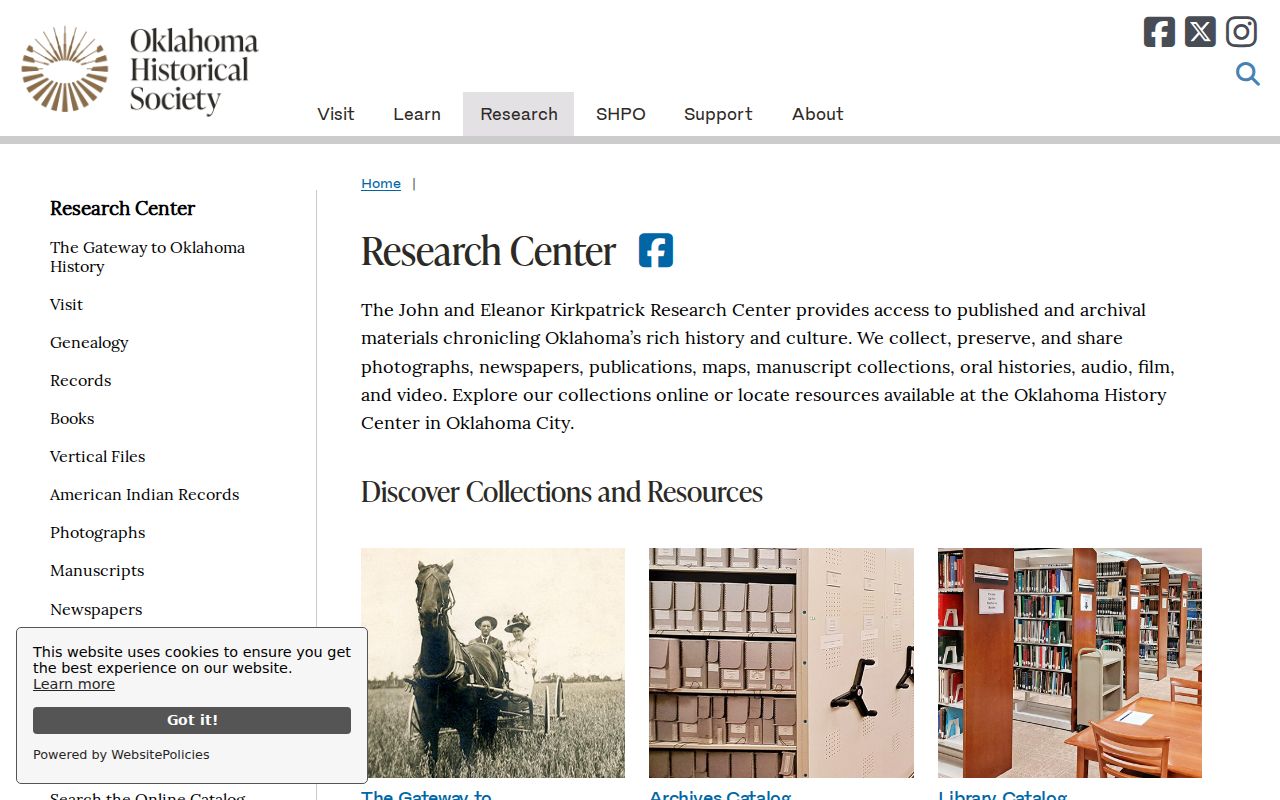
OHS works best as a companion shelf: a directory supplies a date and address, then a census, yearbook, map, manuscript, or newspaper may provide the next record to inspect. Restrictions and indexing vary, so a zero result is not an exhaustive answer.
Owasso City Directory Clues in the Ledger
The Owasso Ledger collection at OHS Gateway is a small but concrete local complement to the directory shelves. The weekly began in 1903. The observed digital holdings contain nine issues and 72 pages from December 16, 1904 through March 24, 1905, while the title itself began earlier. Search controls include full text, metadata, title, subject, creator, names, Guided, Advanced, and Proximity search. Those controls can connect a street, a store, an organization, or a public notice to the same period as an entry.
Do not describe the scanned Ledger as a complete newspaper run. It is best used to test a lead from an Owasso city directory, such as a printed business name or a short address form. Microfilm, archive, and library routes remain important when the digital window stops.
Owasso City Directory Dates and Streets
Owasso's address history needs its own timeline. The original town-site plat was signed on March 26, 1904, and the original north-south streets were Oklahoma, Kansas, and Missouri. Eight east-west streets were named for Union and Confederate generals. The city history says those original names changed around 1960. An entry that seems not to match a current map may therefore be using the correct source-era street name.
- 1903: The Owasso Ledger began publication.
- 1904: The original town-site plat was signed.
- 1909 onward: The TCCL guide identifies Tulsa city-directory holdings from this point, with gaps by year.
- 1920 and 1921: Digitized Polk-Hoffhine volumes offer inspectable alphabetical and numerical sections.
- Around 1960: Original Owasso street names changed, creating a key cross-reference for older records.
Keep the source-era spelling beside the present spelling in notes. Directional forms such as av and st, along with r and rms, are part of the historical record. A name and street match becomes much stronger when the year, source wording, and county or municipal context are kept together.
Tracing an Owasso City Directory Household
Use a household trail to connect editions without overstating what any one line proves. Start with the first printed appearance, save the exact form of the name and address, then check later volumes for a move, a changed spouse marker, a different business wording, or a disappearance. Pair directory years with the federal census that is available for the period. The census has household and relationship context; the directory often supplies the closer year-by-year address trail.
- Find the earliest confirmed entry and record the volume year and page.
- Search the next available editions using the name, initials, spouse marker, and printed street form.
- Check the numerical or street section when the volume includes one, then preserve any address variant.
- Pair the dated address with the available federal census, whose current public release reaches 1950 under the 72-year rule.
- Use the TCCL Death Notice Index, cemetery material, probate, or newspapers only as a dated follow-up lead.
A person who drops out of an Owasso city directory may have moved, died, changed how a name was printed, lived outside the book's coverage, or simply been omitted. The Owasso resident lookup route is better for current official-record verification, while the historical volume remains the evidence for its own date.
Owasso Directory Geography Needs Checking
An Owasso mailing label does not settle whether the old or current address belongs to Tulsa County, Rogers County, city limits, or an unincorporated pocket. The approximate city fenceline runs from N Memorial Road to N 241st E Avenue and from E 66th Street North to E 126th Street North, yet parcels inside that planning area can remain county-governed. This matters when a directory entry is followed into a deed, permit, or municipal archive.
The historical value of a 1920 entry is its dated life snapshot: a printed name, spouse marker where supplied, residence or boarding notation, business wording, and street address. It should not be read as a present-tense statement. Match a directory clue to the relevant county records office and confirm the boundary separately before drawing a local conclusion.
Note: Save the edition year, page, printed address, and county or city context together, because one Owasso label can refer to several overlapping geographies.